If you're dealing with arthritis and cooking has started to feel like a battle, I want to be straight with you: the right adaptive cooking tools for seniors with arthritis can change that. Not fix everything — but change it significantly. I work with seniors across the Bay Area who've gone from avoiding the kitchen entirely to cooking full meals again, and a lot of that shift comes down to having the right equipment, not more willpower.
Arthritis affects over 58 million Americans. In the kitchen, it shows up in the most frustrating ways — gripping a knife, twisting open a jar, squeezing a can opener, even holding a spatula steady for a few minutes. These aren't big tasks. But when your joints are inflamed and stiff, they feel impossible.
The good news: there are specific tools designed for exactly these problems. I've used all of these with clients, I know which ones hold up, and I'll give you real prices so you can plan.
What Makes a Kitchen Tool Arthritis-Friendly?
Before getting into the list, here's the framework I use when I'm doing a Kitchen Assessment with a new client. Arthritis-friendly tools share a few traits:
- Reduced grip force required — the tool does the work your hands can't
- Larger handle diameter — thicker handles (1.25 inches minimum, 1.5+ inches ideal) distribute pressure across the whole hand instead of concentrating it in the fingers
- Eliminated twist-and-squeeze motions — these are the movements most likely to aggravate inflamed joints
- Non-slip surfaces — because compensating for a slipping tool creates exactly the gripping force you're trying to avoid
Keep this framework in mind as you shop. A tool that checks all four boxes is worth paying for.
The 7 Best Adaptive Cooking Tools for Seniors with Arthritis
1. Electric Jar Openers: The Single Best Investment
Jar lids are public enemy number one for arthritic hands. Opening a standard vacuum-sealed jar requires significant grip strength plus a twisting motion — a combination that puts direct stress on finger and wrist joints at once. For a lot of my clients, jars had just become off-limits, which meant whole categories of foods (salsa, pickles, pasta sauce, nut butters) were gone.
Electric jar openers fix this completely. You place the device on top of the jar, press a button, and the motor does the rest. No grip, no twist, no force.
What I recommend: Hamilton Beach and Black+Decker both make reliable countertop models for $25–$40. Look for a model with a wide base that accommodates different jar sizes, including wide-mouth mason jars. The Hamilton Beach Open Ease (~$28) is what I point most clients toward first.
This is the tool that gets the fastest reaction during Kitchen Assessments. Clients who've been frustrated with jars for years will test it once and immediately look relieved.
2. Ergonomic Knives with Thick Cushioned Handles
Standard kitchen knife handles were designed for people with full grip strength. They're narrow, hard, and require sustained squeezing to control — none of which works well for arthritic hands. The answer isn't to stop cutting. It's to change the knife.
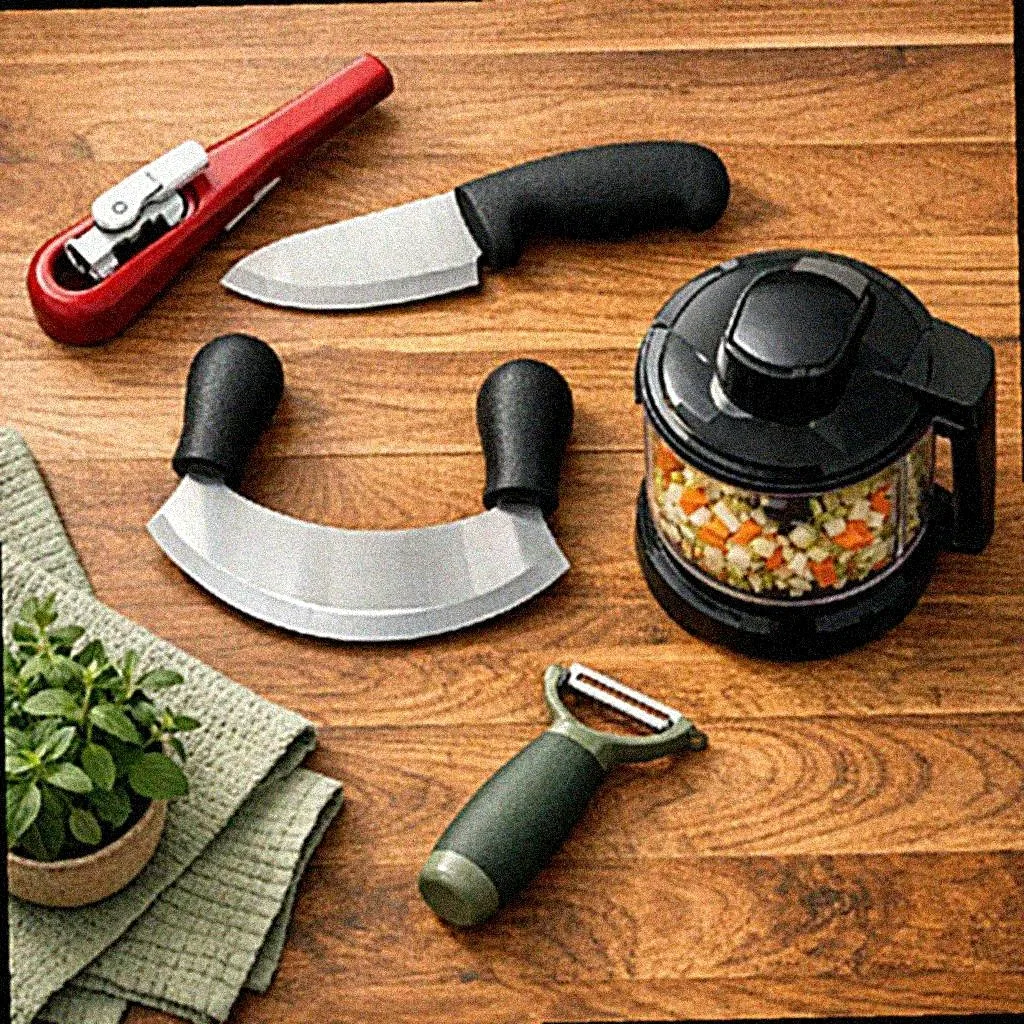
Ergonomic knives for arthritis feature thick, cushioned handles (often soft rubber or foam) that require much less gripping force to control safely. Some designs use a pistol-grip orientation that keeps the wrist in a neutral position and eliminates the awkward downward-pressure grip of a standard knife.
What I recommend: OXO Good Grips chef's knives are widely available at Target, Bed Bath & Beyond, and Amazon — typically $20–$35. Zyliss makes excellent options too. Look for handles at least 1.5 inches in diameter, a non-slip grip surface, and full-tang construction (the blade extends through the full length of the handle) for better balance. A well-balanced knife needs less corrective gripping.
3. Rocker Knives (Ulu Knives): A Game-Changer for Severe Wrist Arthritis
If standard knives are still painful even with ergonomic handles, a rocker knife — sometimes called an ulu knife — changes the entire motion. Instead of lifting and chopping, you rock the curved blade back and forth across the cutting board. The technique requires far less wrist extension and almost no downward impact force.
I started recommending these after working with a client who had severe wrist OA — she'd essentially stopped cooking proteins because slicing felt impossible. After one session with a rocker knife, she was back to prepping chicken and vegetables herself. That's the kind of outcome I'm talking about.
Bonus: Rocker knives with a curved blade and integrated cutting board can be used fully one-handed, which is helpful for anyone with limited function in one arm.
What I recommend: Mezzaluna-style rocker knives run $15–$40 at kitchen stores or online. Paired with a dedicated curved cutting board, they're one of the more transformative tool upgrades I recommend for clients with moderate-to-severe wrist involvement.
4. Electric Can Openers: Low Cost, High Impact
Manual can openers require grip plus squeeze plus rotation simultaneously — a brutal combination for arthritic hands. A good electric can opener removes all of that effort. You attach it to the can, press a button or lever, and it runs on its own.
This is one of the highest-return investments in the adaptive kitchen, and it costs almost nothing.
What I recommend: One-touch countertop electric can openers by Cuisinart or Hamilton Beach run $20–$50 and are available at any big-box store. Wall-mounted electric models are even more convenient because they don't need to be retrieved from storage — but countertop is fine for most kitchens.
5. Loop (Self-Opening) Scissors
Standard scissors require sustained squeezing force to cut. Loop scissors — also called self-opening or spring-loaded scissors — use a spring mechanism so the blades open automatically. You only need to squeeze to close them; the spring does the opening. That halves the muscular work per cut.
For clients who use scissors regularly to open packages, cut herbs, trim poultry, or portion pizza, this small swap prevents significant daily discomfort.
What I recommend: Loop scissors are available at medical supply stores and on Amazon for $10–$20. They're an easy add that most people don't know about until someone tells them.
6. Non-Slip Mats and Cutting Boards with Suction Cups
When grip is compromised, the risk of items shifting while you work goes up — and a slipping knife or sliding bowl is a real safety concern, not just an inconvenience. Non-slip mats and cutting boards with suction cup feet or rubberized bases anchor your workspace and reduce the compensatory gripping that comes from trying to hold things steady.
Immediate fix: A damp cloth under any cutting board is a zero-cost way to stabilize it right now.
Longer-term: Dycem non-slip matting ($8–$20/roll) can be cut to any size and placed under plates, bowls, appliances, and cutting boards throughout the kitchen. It's one of the tools occupational therapists reach for most often. Suction-cup cutting boards (like those from Calphalon or various adaptive equipment suppliers) are great for clients who need both hands free — they lock onto the counter so neither hand needs to stabilize.
7. Weighted Utensils: Counterintuitive but Effective
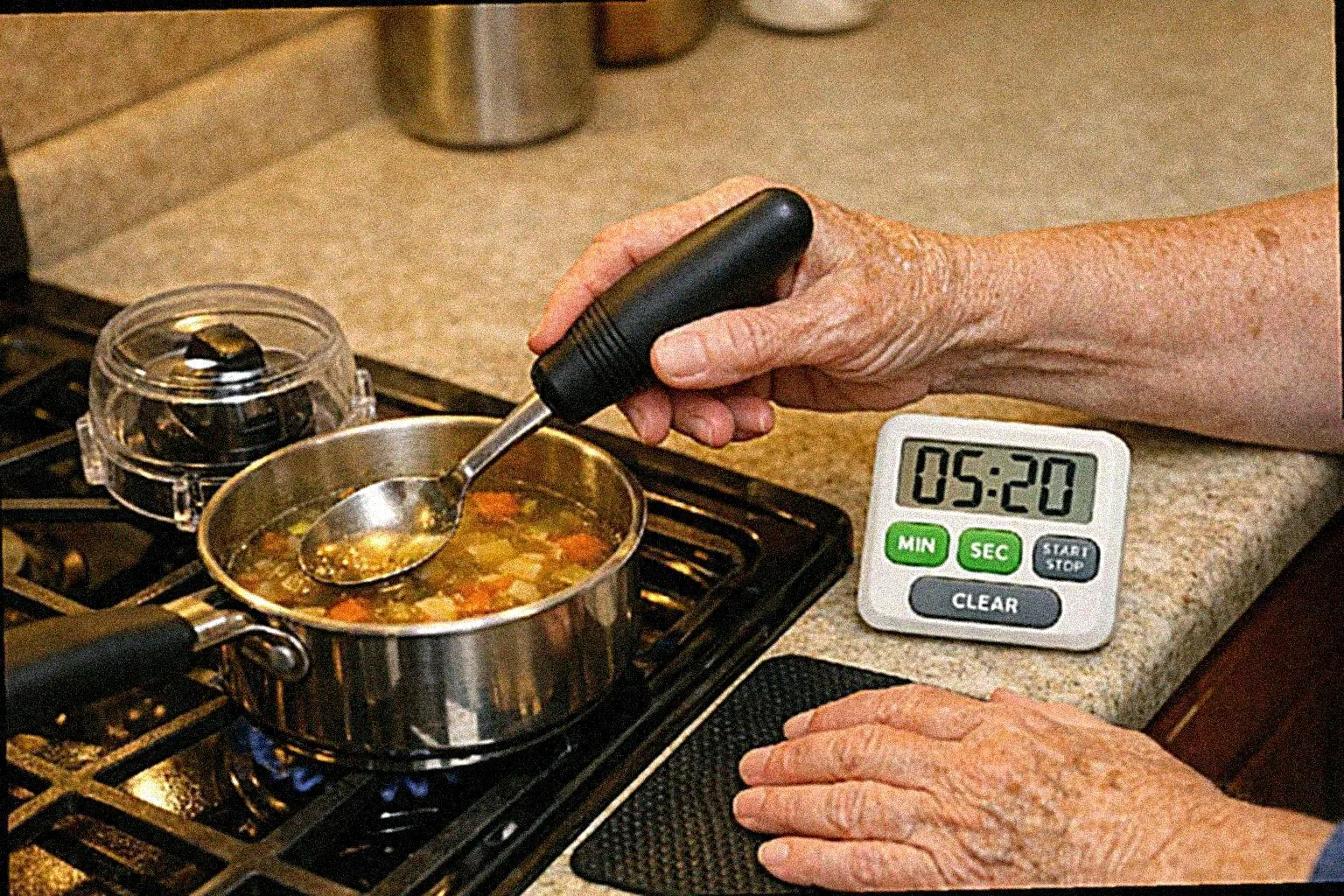
This one surprises almost every client I bring it up with. You'd think lighter utensils would be easier for arthritic hands — but for many people, weighted utensils are actually easier to control. The added weight (typically 6–8 oz) provides proprioceptive feedback that steadies hand movement and reduces the micro-corrections that fatigue the joints.
If arthritis is accompanied by any tremor — which is common, and which also shows up in cooking for seniors with Parkinson's disease — weighted utensils make an even bigger difference.
What I recommend: Weighted spoons, forks, and knives are available from adaptive equipment suppliers like Kinsman and North Coast Medical, and on Amazon — typically $15–$30 per piece. If you want to try the concept cheaply first, wrap electrical tape around the handle of an existing spoon to add some weight and see if it helps before investing.
How to Set Up an Arthritis-Friendly Kitchen (Beyond the Tools)
The tools matter, but so does the setup. A few quick wins I recommend to every client:
Reorganize for the 24-inch rule. Everything you use daily should live between hip height and shoulder height — no reaching up, no crouching down. Overhead reaching with arthritic shoulders is painful and dangerous. Get the pots, pans, and pantry staples into the "sweet zone."
Prep stool or chair. Standing for long prep sessions is exhausting when joints are painful. A sturdy bar stool at counter height lets you do most prep work seated. This isn't a concession — plenty of professional cooks sit during prep.
Reorganize your tool drawer. Keep the adaptive tools you're actually using at the front, easy to grab. If the electric jar opener is buried behind the old manual one you don't use anymore, you'll default to the wrong tool.
If you're in the San Francisco Bay Area and want a personalized look at what would help most in your specific kitchen, book a free Kitchen Assessment. I'll walk through your setup, identify the highest-impact changes, and help you prioritize — no overwhelming list, just the stuff that will actually make a difference.
For related reading, check out the adaptive cooking guide for Parkinson's disease, the wheelchair-accessible kitchen organization guide, and our kitchen safety tips for elderly parents living alone.
Frequently Asked Questions
What are the best adaptive cooking tools for seniors with severe arthritis?
For severe arthritis, the highest-impact tools are electric jar openers ($25–$40), ergonomic knives with thick cushioned handles ($20–$35), and non-slip Dycem matting to stabilize surfaces without gripping. An electric can opener ($20–$50) and loop scissors ($10–$20) round out a strong starter kit that addresses the most painful daily tasks without requiring a major kitchen overhaul.
Are ergonomic kitchen tools for arthritis covered by insurance or Medicare?
Most adaptive kitchen tools are not covered by Medicare Part A or B as standalone purchases. However, if an occupational therapist prescribes specific adaptive equipment as part of a documented treatment plan, some items may be covered under a Medicare Advantage plan or a supplemental insurance plan. It's worth checking with your specific plan. Some independent living programs in the Bay Area also have equipment lending libraries.
How do I know which adaptive tools will actually help my arthritis?
The most reliable way is a kitchen assessment with someone who understands both adaptive equipment and occupational function — not just browsing Amazon reviews. What helps depends on which joints are affected, how severely, and which kitchen tasks you actually do regularly. Wrist arthritis calls for different adaptations than finger arthritis. A one-size-fits-all list often misses the specific tools that would make the biggest difference for your situation.
Can adaptive kitchen tools help with both arthritis and Parkinson's tremors?
Yes — several tools overlap. Weighted utensils specifically address tremors and are recommended for both conditions. Non-slip mats, electric openers, and ergonomic handles also benefit both. That said, Parkinson's introduces some additional considerations (medication timing, fatigue cycles, swallowing changes) that go beyond what arthritis tools alone address. See the full Parkinson's cooking guide for more detail.
Where can I buy adaptive cooking tools for arthritis in the Bay Area?
Many adaptive tools are available at Target, Bed Bath & Beyond, and Amazon. For more specialized equipment (weighted utensils, suction-cup cutting boards, Dycem matting), look at medical supply stores, OT equipment suppliers like North Coast Medical and Kinsman, or search Amazon specifically for "adaptive cooking" or "OT kitchen equipment." A kitchen assessment can help you build a shopping list targeted to your actual needs before you spend money on things that won't help.
Looking for help with adaptive cooking? Learn about our Adaptive Cooking service →
We'll walk through your specific kitchen situation together — no pressure, no commitment.
Book Your Free Kitchen Assessment