The most important cooking tips for seniors with Parkinson's disease aren't about complicated equipment or expensive renovations. They're about understanding how the disease affects movement — and then working with it instead of against it. I work with families across the Bay Area navigating exactly this, and the difference between a kitchen that works and one that doesn't usually comes down to a handful of targeted changes, not a complete overhaul.
Parkinson's affects roughly 10 million people worldwide. The motor symptoms — tremors, muscle rigidity, slowed movement, balance issues — interact directly with cooking in ways that are predictable once you understand them. A knife requires fine motor grip. A hot stove demands quick reaction time. Carrying a pot of boiling water requires steady hands and balance at the same time.
The instinct for families is often to take over the kitchen entirely. I get it — the fear of a burn or a fall is real. But for most people with Parkinson's, especially in the early and middle stages, cooking is deeply tied to identity and independence. Removing that completely does real damage. The goal is to adapt the kitchen so the person can participate safely as long as possible — not to remove them from it.
Here's what I've learned working with Parkinson's patients and their families in the San Francisco Bay Area.
How Parkinson's Disease Actually Affects Cooking
Understanding the specific symptoms helps you choose the right adaptations. These are the ones I see show up in the kitchen most often:
Tremors create problems with fine motor tasks — gripping small handles, pouring liquids precisely, bringing a fork to the mouth without spilling. Importantly, Parkinson's tremors are typically worse when holding a static position (called a postural or resting tremor) than during purposeful movement. That means some tasks are actually more manageable mid-motion.
Rigidity and reduced range of motion affect overhead reaching, opening containers, and sustaining grip over time. Anything requiring extension or sustained muscle engagement becomes more fatiguing and less reliable.
Bradykinesia — the slowness of movement characteristic of Parkinson's — means tasks that once took two minutes can take ten. This is not cognitive impairment. It's a motor processing issue. Rushing doesn't help; it increases error rate and fall risk.
Balance issues and freezing make standing at a stove or carrying heavy items across the kitchen dangerous, particularly on hard flooring. Freezing — where movement suddenly stops mid-task — is unpredictable and happens in narrow passages.
Dysphagia (swallowing difficulty) affects roughly 80% of people with Parkinson's at some point. It's less discussed than tremors but medically serious. Food texture choices matter and the stakes are high — aspiration pneumonia is a leading cause of death in advanced Parkinson's.
Fatigue and medication cycles are the piece most families miss initially. Parkinson's medications wear off between doses, and there are distinct "on" windows (medication working, symptoms controlled) and "off" windows (medication fading, symptoms worse). Cooking during an off window is harder, slower, and less safe. Timing matters.
Adaptive Tools That Make the Biggest Difference
Weighted Utensils for Tremor Control
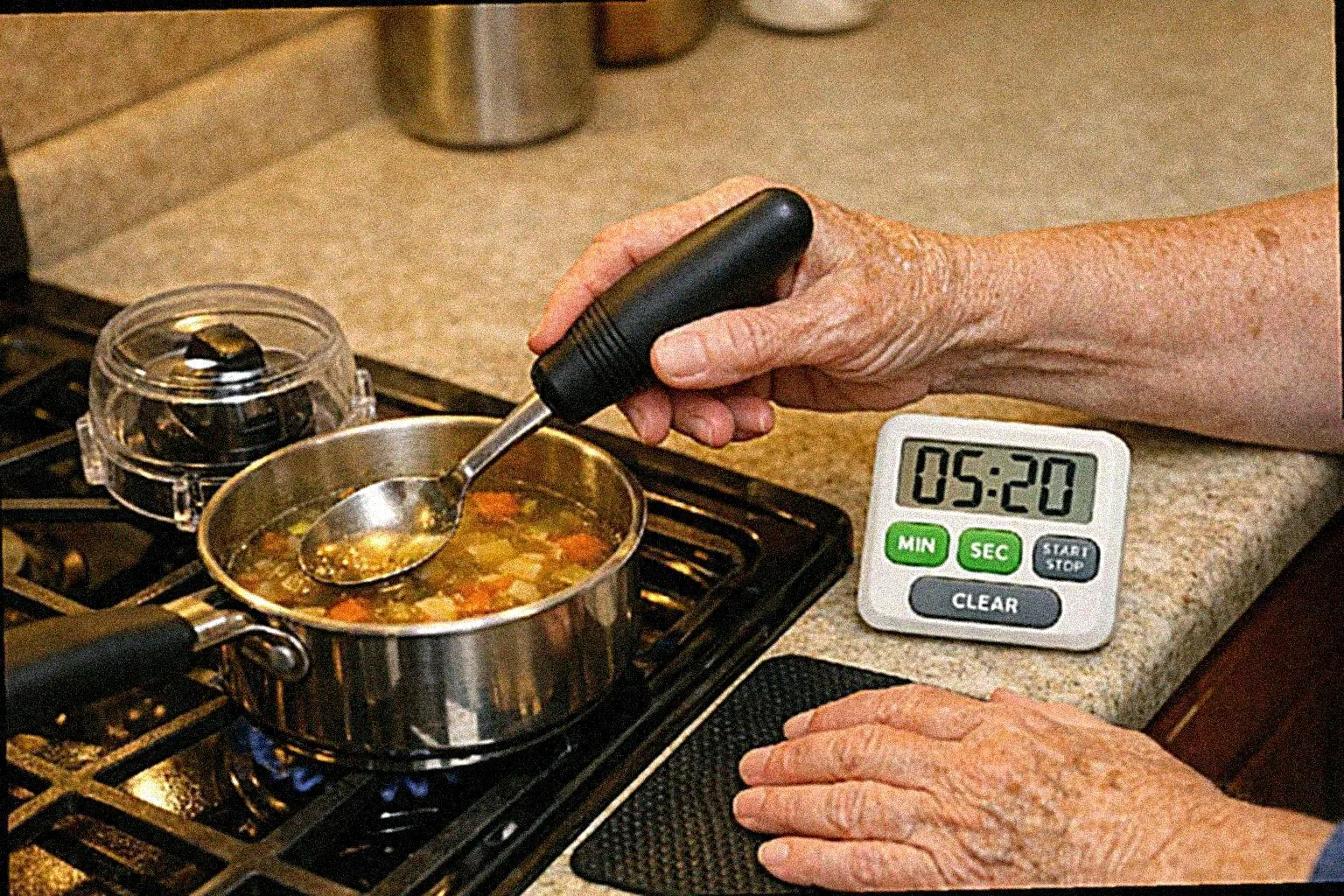
This is the first thing I reach for with Parkinson's clients. Weighted spoons, forks, and knives add 6–8 oz of resistance that counters involuntary tremor motion. The added weight provides proprioceptive feedback — your nervous system can feel the utensil better — and that improves control. These aren't gimmicks. They're what occupational therapists reach for first.
Look for utensils specifically designed for tremor management, not just general adaptive use. Liftware makes a line of electronic stabilizing utensils (the spoon actively counteracts tremor motion using sensors — expensive at $195+, but remarkable for severe tremors). For moderate tremors, Weighted Utensils USA and similar brands make heavier standard-style utensils for $15–$30 each.
We also cover weighted utensils in the adaptive cooking tools guide for seniors with arthritis — they help with both conditions, though for different reasons.
A Seated Kitchen Setup
The single most impactful change for many Parkinson's patients isn't a tool — it's posture. Moving kitchen prep from standing to seated removes balance and fatigue from the equation for almost every prep task. A sturdy stool at counter height, or a work surface lowered to 28–32 inches, means tremors and balance aren't fighting gravity at the same time.
If a full counter modification isn't feasible (and in a rental kitchen, it often isn't), a sturdy rolling cart set at the right height can serve as a dedicated prep station. This is a $50–$150 solution that doesn't require any installation.
Electric Appliances Instead of Manual
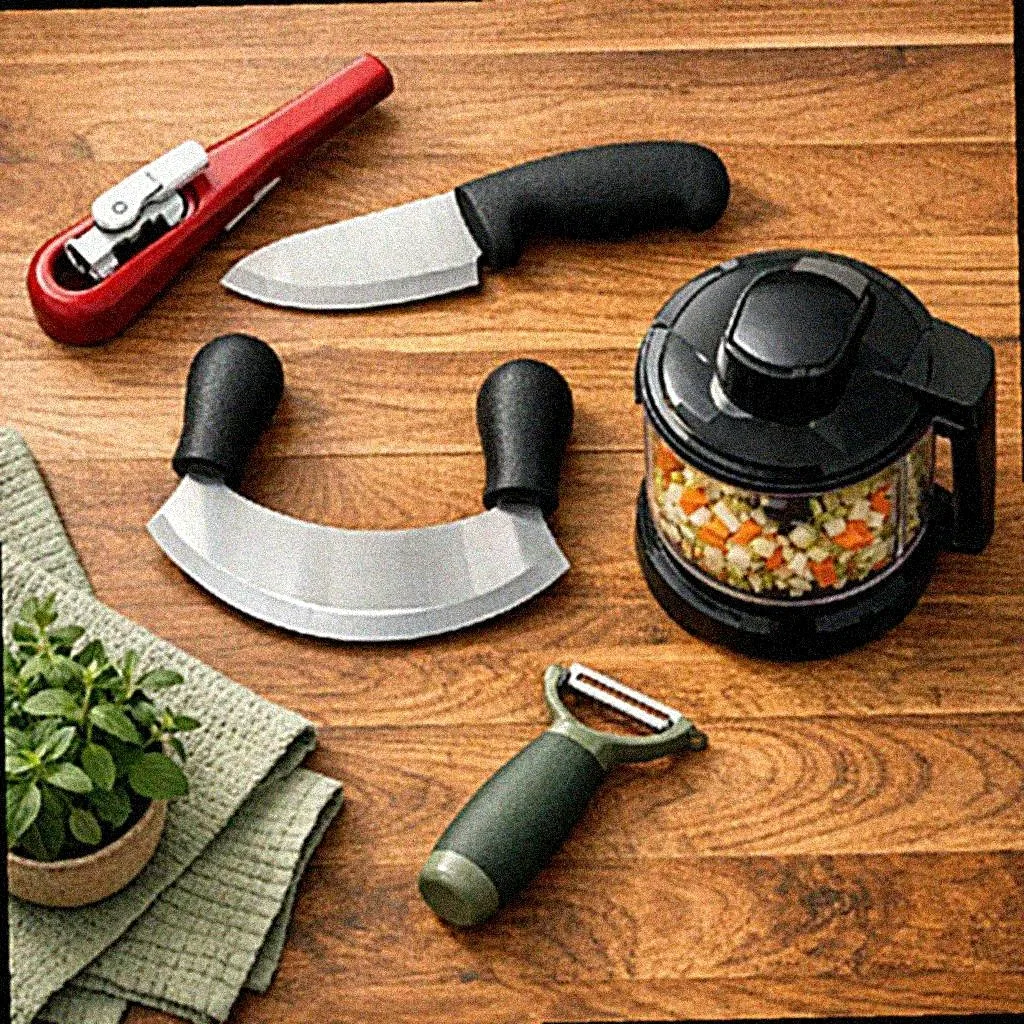
Every manual task that can be replaced with an electric one should be. The combination of grip and fine motor control required for manual kitchen tasks is exactly what Parkinson's erodes. Electric alternatives remove that dependency:
- Electric can opener — no grip-and-twist required (~$20–$50)
- Food processor — replaces sustained knife work for chopping (~$50–$150)
- Electric jar opener — eliminates vacuum-seal jar struggles (~$25–$40)
- Stand mixer or hand mixer — replaces hand-whisking
- Electric kettle with a wide, stable base — much safer than lifting a stove pot to pour hot water
- Slow cooker or Instant Pot — replaces active stovetop monitoring; set it and walk away
The Instant Pot deserves special mention: it turns what would be 30–40 minutes of active stovetop work into 8 minutes of prep and hands-off cooking. For someone managing fatigue cycles, that difference is significant.
Non-Slip Dycem Mats
Non-slip Dycem matting under bowls, plates, cutting boards, and appliances prevents sliding when grip is unreliable. Suction-cup bowl bases achieve the same thing. These are inexpensive (Dycem rolls run $8–$20), instantly useful, and one of the most-recommended tools by occupational therapists working with neurological conditions.
Handle Grip Adapters
If grip is the primary challenge but replacing all utensils isn't in the budget, foam tubing grip adapters (available at any adaptive supply store for $5–$15) slip over existing handles to increase diameter and reduce required grip force. This makes existing tools more usable without replacing everything at once.
Meal Prep Strategies for Parkinson's Caregivers
Cook During "On" Time — This Is Non-Negotiable
If the person with Parkinson's is participating in their own cooking, schedule all prep sessions during the on-time window: typically 30–60 minutes after a medication dose, before it starts to wear off. This is when tremors are most controlled, movement is easiest, and the risk of accidents is lowest.
Short, focused sessions during on-time (20–30 minutes) are dramatically more productive and safer than longer sessions that drift into off-time. Learn the person's medication schedule and build cooking around it. "Let's make the week's soups on Sunday morning, an hour after your 8 a.m. dose" is a meal prep plan. "Let's cook whenever" is not.
Prioritize Soft, Easy-to-Manage Foods
As Parkinson's progresses, food texture needs to be assessed with both swallowing safety and tremor management in mind. Foods that are soft, moist, and easy to manage with a utensil reduce both aspiration risk and frustration at mealtimes.
Good choices:
- Scrambled eggs, soft-boiled eggs
- Fish (salmon, cod, tilapia — all naturally soft when cooked properly)
- Ground proteins (ground turkey or chicken) instead of whole cuts that require cutting
- Well-cooked vegetables (roasted or steamed soft — not raw)
- Smooth soups, pureed dishes
- Soft fruits: banana, ripe melon, ripe pear, canned peaches in juice
- Oatmeal, yogurt, cottage cheese
Avoid or limit:
- Crumbly dry foods (dry crackers, dry bread) — hard to manage with tremors and aspiration risk
- Sticky dense foods (peanut butter straight from the spoon)
- Very thin liquids if swallowing is impaired (see thickeners section below)
- Foods requiring significant cutting at the table
A Sample Batch Prep Session for Parkinson's
A Sunday batch cooking session focused on Parkinson's-appropriate foods might produce:
- Shredded chicken thighs — roasted and pulled from bone. No cutting required at mealtime; just scoop and serve. 3 lbs of thighs = 5–6 servings.
- Soft-cooked red lentils — can be served as soup, stirred into stew, or used as a soft side. 1 cup dry lentils = 4–5 servings, 25g protein total.
- Baked salmon fillets — portioned individually before cooking. Two portions for mid-week; two in the freezer.
- Mashed sweet potatoes — portioned into 4 oz containers. Reheat with a splash of broth to keep them moist.
- Overnight oat base — stir together rolled oats, milk, and mashed banana the night before. Zero morning cooking required.
For more batch prep strategies, the batch cooking guide for family caregivers covers the full system.
Thickened Liquids When Prescribed
If a speech-language pathologist has assessed swallowing and recommended thickened liquids, this is not optional. All beverages — water, broth, juice, coffee, tea — need to be thickened to the prescribed level. Thin liquid aspiration is a leading cause of aspiration pneumonia, which is a serious and potentially fatal complication.
Commercial thickeners like SimplyThick and Thick-It mix into any liquid and are available at most pharmacies and on Amazon. SimplyThick is gel-based and tends to stay thickened longer without over-thickening; Thick-It is powder-based and less expensive. Ask the SLP which consistency level is appropriate (IDDSI levels 1–4) and verify that you're mixing to that level.
Kitchen Safety for Parkinson's Disease
Remove trip hazards from floor paths. Secure loose rugs — especially in front of the stove and sink. Install grab bars near the sink if not already present. In tight kitchens, consider whether appliance placement is creating narrow passages where freezing episodes could be dangerous.
Induction over gas. Induction surfaces don't stay hot after the pan is removed, which dramatically reduces burn risk for someone with delayed reaction time. A portable induction burner (~$40–$80) placed at an accessible counter height doesn't require installation and is a realistic upgrade for most kitchens. It's worth it.
Auto stove shut-off devices. If the person cooks or reheats alone, a stove that gets left on is a serious fire risk. Devices like Wallflower and iGuardStove detect if a burner has been on too long without movement nearby and shut it off automatically. These install without professional help and run $50–$150.
The two-foot sliding rule for hot items. Nothing hot moves more than two feet by lifting. Instead of carrying a pot from stove to sink, slide it along the counter. This is a technique I teach in every first kitchen session with a Parkinson's client — it's simple, and it removes one of the biggest burn and spill risks.
See also the kitchen safety guide for elderly parents living alone for a broader safety checklist.
Planning Ahead as Parkinson's Progresses
Parkinson's is progressive. The adaptations that work well today will need to evolve over the next 6–12 months. The goal isn't a permanent solution — it's to stay about six months ahead of the current level of challenge.
What I recommend to families I work with: a conversation with an occupational therapist every 6–12 months to catch what's changing before it becomes a crisis. And having someone who understands Parkinson's come in regularly for meal prep support — whether that's a caregiver, a family member, or a service like Well Prepped Life — ensures food quality and safety stay consistent even as the cooking the person can do safely decreases.
The person doesn't have to be fully in charge of cooking to still be meaningfully involved. Stirring, seasoning, plating, choosing what to make — these are all ways to stay connected to food and the kitchen, even when independent full-meal cooking is no longer safe.
If you're in the Bay Area and managing Parkinson's-related kitchen challenges — for yourself or a loved one — book a free Kitchen Assessment. I understand how the disease progresses and how to build kitchen systems that adapt over time, not just for right now.
Frequently Asked Questions
What are the best utensils for someone with Parkinson's tremors?
Weighted utensils are the most consistently recommended tool for Parkinson's tremors. Look for utensils specifically designed for tremor management — standard weighted utensils run $15–$30 each, while Liftware electronic stabilizing spoons ($195+) actively counteract movement for severe tremors. Non-slip Dycem mats under plates and bowls are an essential companion tool that prevents dishes from sliding when grip is unreliable.
When should someone with Parkinson's stop cooking independently?
There's no universal threshold — it depends on what they're cooking, how their symptoms are progressing, and what adaptations are in place. Most people can cook safely well into moderate Parkinson's with the right setup: seated workstation, electric appliances, auto stove shut-off, someone checking in. The point to significantly reduce independent cooking is when there are repeated near-accidents, when medication timing can no longer be reliably maintained, or when balance has declined to the point where the stove area is genuinely dangerous unsupervised.
How does medication timing affect cooking with Parkinson's?
Significantly. Parkinson's medications (typically carbidopa-levodopa) have clear on/off windows. During "on" time — roughly 30–60 minutes post-dose — tremors and rigidity are most controlled. During "off" time, as the medication wears off, symptoms worsen noticeably. Scheduling all cooking and prep during on-time windows makes sessions safer, faster, and less frustrating. This is one of the first things I help families establish.
What foods are easiest to eat with Parkinson's tremors?
Soft, moist foods that don't require precision cutting or complicated fork technique at the table. Shredded proteins, soft-cooked fish, scrambled eggs, smooth soups, mashed vegetables, and ripe soft fruits are all good. Avoid crumbly dry textures (dry crackers, dry bread) that are hard to manage with utensils and create aspiration risk. If a speech-language pathologist has identified swallowing difficulty, all food and liquid choices should be coordinated with their recommendations.
Is there Bay Area in-home support available for Parkinson's meal prep?
Yes — Well Prepped Life provides in-home meal prep services specifically for seniors and disabled adults in the San Francisco Bay Area, with experience supporting clients with Parkinson's disease. A free Kitchen Assessment is the starting point: we walk through the kitchen, assess current challenges, and build a support plan. Book here. For broader independent living support, the Center for Independent Living in Berkeley (thecil.org) also maintains referral networks for in-home support services.
Looking for help with adaptive cooking? Learn about our Adaptive Cooking service →
We'll walk through your specific kitchen situation together — no pressure, no commitment.
Book Your Free Kitchen Assessment