Cooking life skills for disabled adults in the Bay Area isn't a niche service — it's a fundamental part of independent living that doesn't get nearly enough attention. I work with adults across the San Francisco Bay Area who live with spinal cord injuries, cerebral palsy, MS, limb differences, and other physical disabilities. Almost universally, the kitchen is identified as one of the spaces where independence matters most — and where the gap between what someone wants to do and what their environment allows them to do is biggest.
The standard kitchen was not designed with disabled adults in mind. Counter heights are wrong. Appliances are in the wrong places. Most tasks are set up to require two fully functional hands and the ability to stand for extended periods. None of that is inevitable. Most of it is fixable — not with a $50,000 renovation, but with the right instruction, the right adaptive tools, and some thoughtful reorganization.
This post is for disabled adults pursuing independent living, for their families and support workers, and for occupational therapists and independent living specialists who are looking for specialized in-home cooking support in the Bay Area.
Why Cooking Skills Are a Core Independent Living Skill
There's a distinction I make with every client I work with that doesn't always get made in disability care: cooking for someone is fundamentally different from teaching someone to cook for themselves.
Both have their place. On high-pain days, high-fatigue days, or days when time is short, having ready-made food available is genuinely valuable. I'm not anti-caregiver cooking — I do it myself as part of this work. But over-reliance on having everything done for you, especially in the kitchen, erodes independence and confidence over time. The kitchen is one of the most identity-laden spaces in a person's life. Losing access to it isn't just an inconvenience.
Adaptive cooking instruction is a different service. It's working alongside someone in their own kitchen to figure out:
- What they can already do independently
- What they can do with the right adapted tools or kitchen setup
- Which techniques make previously difficult tasks actually doable
- What reorganization changes reduce barriers without requiring a contractor
- Where the smart shortcuts are — the ones that save energy for what matters, not the ones that remove capability
The goal is maximum independence with minimum unnecessary friction.
Who Benefits from Adaptive Cooking Instruction?
Wheelchair Users and People with Limited Lower-Body Mobility
Standard kitchens aren't built for seated work. Counter height (typically 36 inches) is designed for standing adults. Reach zones, appliance placement, and aisle width all affect what's independently accessible from a wheelchair. Adaptive cooking instruction covers both technique — how to cook from a seated position efficiently — and environment — how to reorganize your specific kitchen so more of it is within reach without asking for help.
For a detailed look at kitchen organization for wheelchair access, see the wheelchair accessible kitchen organization guide.
Adults with Upper-Body or Hand Limitations
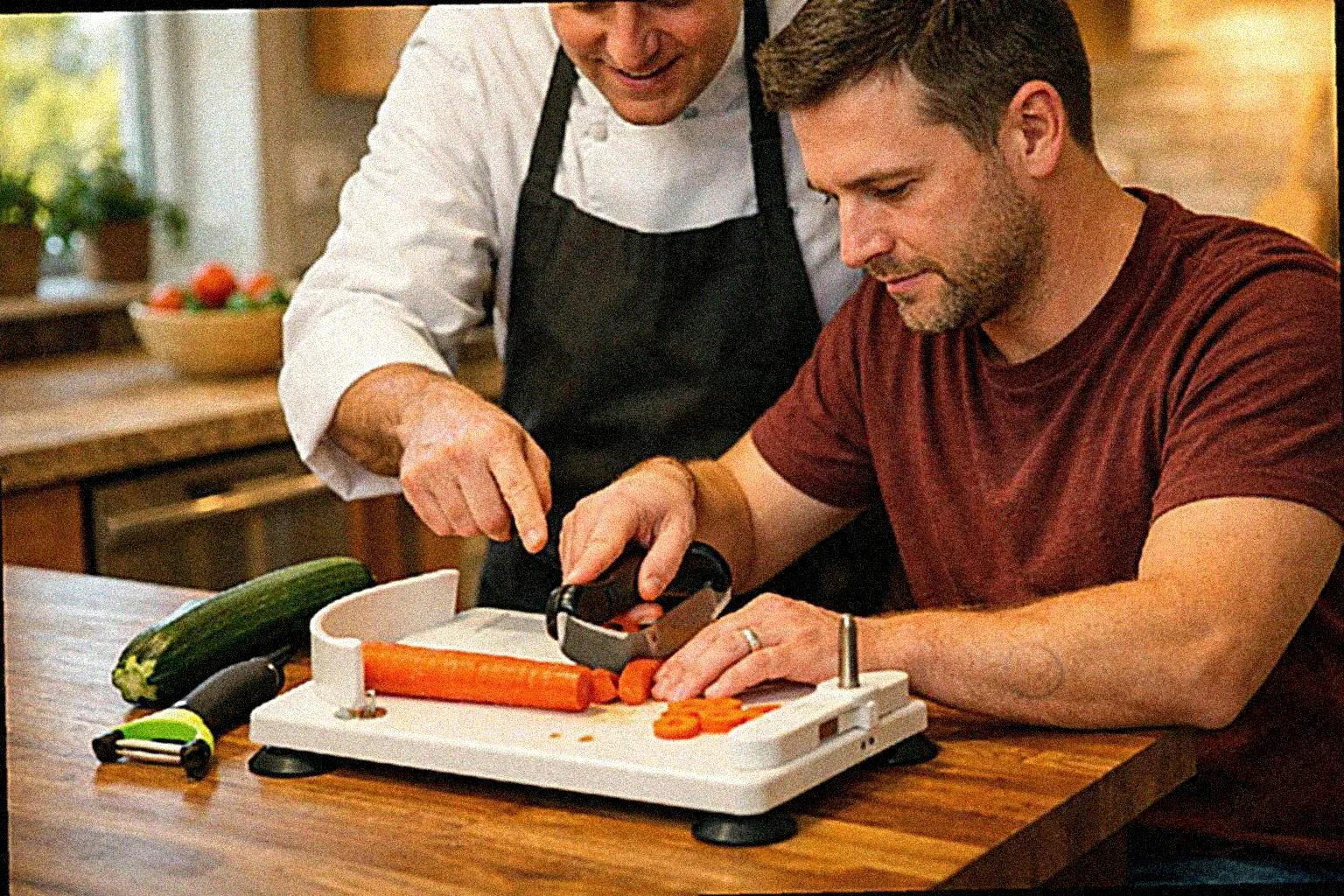
One-handed cooking is entirely possible with the right equipment and technique. A single hand can open a jar, stir a pot, and safely handle a knife — with the right setup. This is something I demonstrate in every first session with a new client who's worried that upper-body limitation means kitchen limitation. Suction-cup cutting boards with food spikes, electric openers, non-slip Dycem mats, and modified knife techniques open up the full range of kitchen tasks. Adaptive cooking tools covers the specific equipment in more detail.
Adults with Chronic Fatigue or Pain Conditions
MS, lupus, fibromyalgia, EDS, and similar conditions make sustained physical effort in the kitchen exhausting in ways that aren't always visible. Adaptive cooking for fatigue conditions focuses on energy management — how to structure prep sessions around energy cycles, which shortcuts preserve function for later in the day, and how to set up a kitchen that requires minimum reaching, lifting, and standing time. This is hella underserved in most meal prep or cooking instruction contexts.
Adults with Progressive Neurological Conditions
For Parkinson's, ALS, or progressive MS, cooking skills taught early in the disease process extend safe, meaningful kitchen participation significantly longer than waiting until limitations become severe. A proactive approach — building adapted habits and setting up the kitchen correctly while the person still has good function — means the adaptations are already in place when they're needed, rather than scrambling to catch up. The Parkinson's cooking tips guide goes into depth on that specific condition.
Adults with Developmental Disabilities Transitioning to Independent Living
Adults with developmental disabilities who are moving into supported or independent living often need kitchen skills that were never formally taught in a structured way. Adaptive cooking instruction that's hands-on, patient, grounded in real meals and real preferences — not abstract cooking theory — builds genuine capability that carries over into daily life. This is some of the most meaningful work I do.
Adaptive Techniques That Make Independent Cooking Possible
One-Handed Cooking
A surprisingly wide range of kitchen tasks can be done with one hand — but most require either a different technique or a specific adaptive setup to work safely.
Cutting: A Dycem mat under the cutting board prevents slipping. A suction-cup cutting board with food spikes (like those from Etac or North Coast Medical) holds items still for cutting without a second hand to stabilize. For harder vegetables, a bowl on a non-slip mat gives a stable surface to brace against.
Mixing and stirring: A bowl on a non-slip mat doesn't need to be held. An electric hand mixer eliminates hand-whisking. Long-handled silicone spatulas reduce wrist movement and work well with one hand.
Opening containers: Electric jar openers, pull-tab can openers, and lever-style bottle openers are all operable single-handedly. These run $10–$40 and are widely available.
Stabilizing food for cutting: A plate guard (a frame that attaches to a plate with a raised edge) can brace food for one-handed cutting. A damp cloth under a cutting board is a zero-cost stabilizer for lighter work.
Seated Cooking
Most kitchen tasks can be done seated with the right setup. The standard counter height of 36 inches is 4–8 inches too high for most wheelchair users. Key parameters for an accessible work surface:
- Counter or prep surface height: 28–32 inches from the floor
- Knee clearance: at least 27 inches of clearance under the surface to allow forward approach
- Cooktop position: a portable induction burner at counter height (or installed cooktop at accessible height) replaces a standard standing stove for most cooking tasks
- Refrigerator: side-by-side or French door configurations provide more accessible storage than top-freezer models
When full kitchen modification isn't feasible — in a rental, in shared housing, or on a limited budget — a rolling kitchen cart set at 28–32 inches is a $50–$150 solution that creates an accessible prep station without requiring any installation or landlord approval.
Energy Management for Fatigue Conditions
For conditions where energy depletion is the primary barrier, cooking instruction looks very different from standard meal prep.
Break prep into short windows. Rather than one long session, work in 15–20 minute segments with rest built in. A batch of grains in the morning, a protein in the afternoon — both are in the fridge by evening without sustained effort.
Use passive cooking time as rest time. The oven, a simmering pot, and a rice cooker all run without you. Start something cooking, sit down for 20–25 minutes, come back to finish. This is not laziness. It's smart energy budgeting.
Front-load higher-energy days. When you have more energy — whether that's a certain time of day or a certain day of the week — do all the prep work. Lower-energy periods are for assembly only: pull prepped components from the fridge and combine.
Know which appliances save the most effort. An Instant Pot turns 30–40 minutes of active stovetop management into 8 minutes of prep and hands-off cooking. A slow cooker converts 10 minutes of morning prep into a fully cooked dinner by evening. For someone managing a fatigue condition, these aren't cooking gadgets. They're accessibility equipment.
What a Cooking Life Skills Session Actually Looks Like
I want to be specific about this, because the term "cooking instruction" can sound like a class — which is not what this is.
When I work with a disabled adult on cooking life skills in the Bay Area, a first session typically covers:
- A kitchen walkthrough — what's where, what's hard to reach, what currently works, what doesn't. I'm looking at everything: cabinet heights, appliance placement, tools available, floor space.
- A conversation about actual goals — not generic "I want to cook" goals, but specific ones. What meals do you want to make? What would feel like a meaningful win in the first two weeks?
- Working through 2–3 real cooking tasks together — not demonstrations, but side-by-side practice with actual food. This is where we figure out what's working and what isn't in a real context.
- Identifying specific barriers and targeted solutions — is it jar opening? Grip on the knife? The stove being out of reach? Each barrier usually has a specific fix, and finding the right one is the whole point.
- A simple, doable plan — one or two changes to try before the next session. Not an overwhelming list of 15 things to buy and reorganize.
Progress builds on itself. Full from-scratch independent cooking may not be the right goal for everyone. But cooking more independently, more confidently, and more safely than before? That's always the right goal.
Bay Area Resources for Disabled Adults and Independent Living
The Bay Area has strong infrastructure for adults with disabilities pursuing independent living. These organizations are worth knowing:
Independent Living Resource Center of San Francisco (ILRCSF) Independent living skills training, peer counseling, and advocacy. ilrcsf.org
The Center for Independent Living (CIL) – Berkeley One of the original centers for independent living in the US. Skills training, assistive technology, community integration. thecil.org
The Arc San Francisco Supports adults with intellectual and developmental disabilities — life skills, employment, community participation. thearcsf.org
Jewish Family and Community Services (JFCS) – Bay Area Independent Living Skills Program for adults with disabilities including hands-on life skills coaching. jfcs.org
These organizations frequently work with outside specialists when their clients need hands-on kitchen support that goes beyond what a general support worker can provide. A cooking life skills specialist is a different skill set than a home health aide or a case manager.
If you're in the Bay Area and want to build more independence in the kitchen — or if you're a family member, support worker, OT, or case manager looking for specialized in-home cooking support — book a free Kitchen Assessment. I work with adults with a wide range of physical disabilities, and I'm glad to talk through what support would actually be useful for your specific situation.
Frequently Asked Questions
What is adaptive cooking instruction for disabled adults?
Adaptive cooking instruction is in-home, hands-on kitchen skills training that's specifically designed around a person's physical capabilities and limitations. It's different from general cooking classes (which assume full physical function) and different from meal prep services (which cook for the person rather than with them). The focus is on building genuine, lasting independent cooking ability using adapted techniques, appropriate equipment, and a kitchen setup that supports rather than fights the person's disability.
How is cooking life skills instruction different from having a caregiver cook for you?
Having a caregiver cook for you addresses the immediate need for food but doesn't build independent capability. Cooking life skills instruction builds capability — teaching techniques, identifying the right adaptive tools, and reorganizing the kitchen so the person can do more independently over time. Both services have their place, and many clients benefit from a combination: life skills instruction to build capability, plus some caregiver meal prep support on high-fatigue days.
What disabilities can benefit from adaptive cooking instruction in the Bay Area?
Adaptive cooking instruction is relevant for a wide range of physical disabilities: spinal cord injuries, cerebral palsy, multiple sclerosis, limb differences, acquired brain injury, Parkinson's disease, ALS, post-stroke deficits, arthritis, fibromyalgia, EDS, and other conditions affecting mobility, grip, balance, or energy. Developmental disabilities affecting adults transitioning to independent living also benefit significantly. The instruction is always individualized — what works for one person's disability and kitchen won't be the right fit for another.
Are adaptive cooking classes available in the Bay Area for disabled adults?
Well Prepped Life provides in-home adaptive cooking instruction in the San Francisco Bay Area — individualized sessions in your own kitchen, not a group class in an unfamiliar space. In-home instruction is typically more effective for building real independence because it accounts for your specific kitchen layout and your specific limitations, not a generic scenario. Book a free Kitchen Assessment to start. For group skills programs, the Center for Independent Living in Berkeley and The Arc San Francisco also offer life skills programming.
How many sessions does it take to build independent cooking skills?
It depends on the person's starting point, their goals, and how their disability affects kitchen function. Many clients see meaningful progress in 3–6 sessions. Some people need ongoing support — particularly for progressive conditions where adaptations need to evolve as function changes. The first session always starts with a clear picture of where things stand and what realistic progress looks like before committing to a longer plan.
Looking for help with cooking life skills? Learn about our In-Home Cooking Lessons service →
We'll walk through your specific kitchen situation together — no pressure, no commitment.
Book Your Free Kitchen Assessment