"How much does a personal chef for seniors cost?" is the most common question I get from families exploring meal prep support for an aging parent. It's a fair question, and I'm going to answer it as transparently as I can — not just for my own service, but for the category in general. Pricing in this industry is often opaque, and families deserve to know what they're looking at before the first phone call.
I run Well Prepped Life, an in-home meal prep service for seniors and disabled adults in the San Francisco Bay Area. I'll share general industry ranges, explain what drives costs up or down, break down what's actually included in a personal chef session versus what you'd pay separately with other options, and compare the per-meal cost against alternatives. By the end of this, you should have a clear picture of whether this kind of service fits your budget.
General Cost Ranges for Personal Chef Services for Seniors
Personal chef services for seniors in the Bay Area typically fall into these ranges:
Per-session pricing: $250–$500+
A single session usually means one visit to the home where the chef plans the menu, shops for ingredients, cooks multiple meals, portions and stores everything in the fridge, and cleans up. A session produces anywhere from 8 to 15+ individually portioned meals depending on the service and the client's needs.
Weekly service: $1,000–$2,000+ per month
For weekly visits — which is the most common frequency — monthly costs typically run $1,000 to $2,000 depending on the number of meals per session, ingredient costs, and the complexity of dietary needs. Some clients do biweekly sessions, which cuts the monthly cost roughly in half.
Grocery costs: Sometimes included, sometimes separate
This varies by provider. Some personal chefs include grocery costs in their session fee. Others bill groceries separately at cost (no markup). At Well Prepped Life, grocery shopping is part of the service — I handle the planning and the shopping — and grocery costs are included in the session pricing so there are no surprise add-ons.
These ranges are for the Bay Area specifically. Costs in lower cost-of-living areas will be lower. The Bay Area premium reflects local ingredient costs, transportation time, and the general cost of doing business in San Francisco and the surrounding counties.
What's Included in a Personal Chef Session
This is where the value calculation gets interesting, because a personal chef session bundles several services that you'd otherwise pay for separately — or that simply wouldn't happen.
Menu Planning
Before each session, I plan a full menu based on the client's dietary requirements, medical needs, personal preferences, and what's fresh and in season. This isn't picking from a pre-set list. It's genuine menu development: considering sodium limits, texture requirements, protein targets, cultural food preferences, what they enjoyed last week, what they didn't, and what their doctor or dietitian has recommended.
For families managing a parent's nutrition remotely, the menu planning alone is a significant time savings. Most adult children I work with were spending hours each week trying to figure out what their parent should eat, whether they were eating it, and how to make it happen from a distance.
Grocery Shopping
I shop for all ingredients before each session. I know which stores have the best produce, where to find specialty items for specific cultural cuisines, and how to select ingredients that work for modified textures or restricted diets. Shopping takes 45–90 minutes depending on the menu, and it's a task that many seniors can no longer do independently and that family members often struggle to manage remotely.
In-Home Cooking
All cooking happens in the client's kitchen. This matters for several reasons:
- The home smells like cooking — a small thing that's actually a big deal for appetite and wellbeing
- I can see what's in the fridge and pantry and notice if something is off (expired food accumulating, signs of not eating)
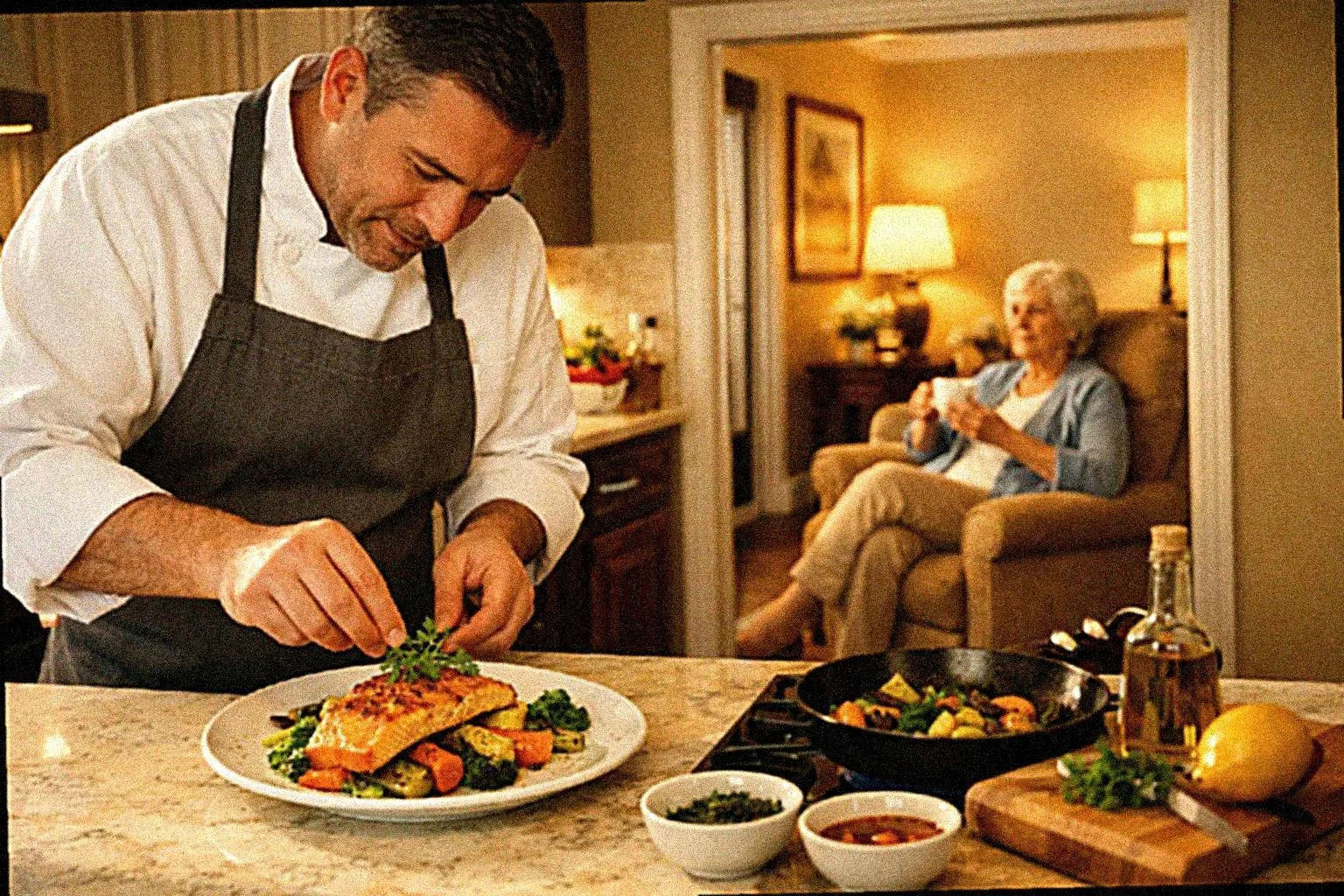
- The client can be as involved or uninvolved as they want — some like to sit in the kitchen and talk while I cook, others prefer to do their own thing
- Food goes straight from stove to fridge — no transport, no temperature issues, no packaging waste
A typical session involves 3–4 hours of active cooking, producing a full week's worth of lunches and dinners (and sometimes breakfasts, depending on the plan).
Portioning and Storage
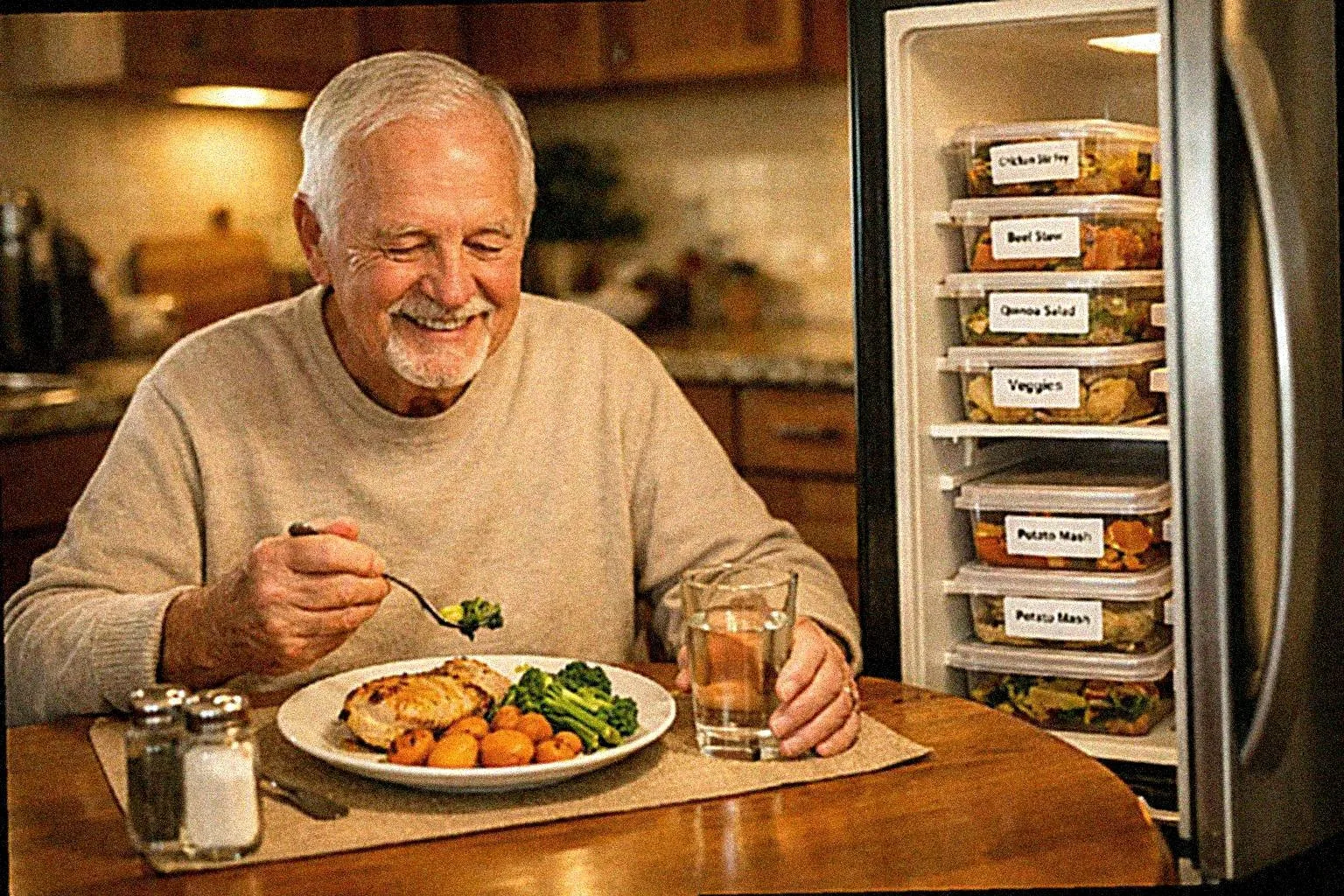
Every meal is individually portioned into containers, labeled with contents and the date, and stored in the fridge organized for easy access. This step matters more than it sounds. For a senior with mild cognitive decline, opening the fridge and seeing clearly labeled, ready-to-eat containers is the difference between eating a real meal and skipping lunch because "there's nothing to eat" — even when the fridge is full of ingredients.
Full Kitchen Cleanup
When I leave, the kitchen is clean. Dishes washed, counters wiped, stove cleaned, trash taken out. The client doesn't lift a finger for cleanup. This is included in every session — it's not an add-on.
What Affects the Cost
Several factors push personal chef pricing higher or lower:
Dietary complexity. A straightforward meal plan for a generally healthy senior costs less to execute than a plan for someone on a renal diet with texture modifications and specific cultural requirements. More complex diets require more specialized ingredients, more careful preparation, and more planning time.
Number of meals per session. Some clients need 8–10 meals to cover lunches and dinners between weekly sessions. Others want 12–15 meals including breakfasts and snacks. More meals means more ingredients and more cooking time.
Ingredient costs. Organic produce, specialty proteins, specific cultural ingredients, and high-quality staples cost more than generic grocery items. I always shop for quality because that's what makes the food worth eating, but ingredient costs are a real variable.
Location within the Bay Area. Travel time varies across the region. A client in San Francisco proper involves different logistics than a client in Walnut Creek or San Rafael. Most personal chef services factor travel into their pricing.
Session frequency. Weekly sessions are the most common and provide the most consistent nutrition coverage. Biweekly sessions cost less per month but mean the client needs another food source for the alternate weeks.
Cost Per Meal: The Comparison That Matters
The session price can sound high in isolation. The per-meal cost tells a more useful story.
Personal chef (in-home, custom): $20–$40 per meal A $300 session that produces 10 meals works out to $30 per meal. That meal is fully custom, cooked fresh with quality ingredients, tailored to specific dietary needs, portioned, stored, and ready to eat. No shopping, no cooking, no cleanup required from the client.
Meal delivery services (shipped frozen): $8–$15 per meal Lower cost per meal, but the food is mass-produced, frozen, shipped, and reheated. Limited customization. Adequate nutrition but rarely food someone looks forward to eating.
Restaurant delivery (DoorDash, Uber Eats): $15–$30+ per meal When you factor in delivery fees, service fees, tips, and the markup on the food itself, a single delivered restaurant meal in the Bay Area easily hits $20–$30. And restaurant food is rarely optimized for senior nutrition — portions are oversized, sodium is high, and consistency is unpredictable. If a senior is ordering delivery 5–7 times per week, the monthly cost can easily exceed what a personal chef would charge, with worse nutritional outcomes.
Eating out: $15–$35+ per meal Similar cost range to delivery, with the added challenges of transportation, physical accessibility, and the energy required to get to a restaurant and back. For many seniors, eating out regularly isn't a practical option even when the budget allows it.
Home care aide meal prep: $30–$45 per hour (aide's time) Home care aides typically bill $30–$45 per hour in the Bay Area. If meal prep takes an hour of the aide's shift, the "cost" of that meal prep is $30–$45 — for food that's usually basic and not professionally prepared. If the aide is making simple meals, the per-meal cost might be comparable to a personal chef, but the food quality is significantly different. For more on this comparison, see personal chef vs home care aide for meal preparation.
Meals on Wheels: Free or donation-based Unbeatable on cost. If budget is the primary constraint, Meals on Wheels is an excellent program. The food quality is institutional, and there's no customization, but it solves the fundamental problem of daily nutrition for seniors who qualify.
The Hidden Costs of Not Having Good Meal Support
This is where the conversation shifts from "how much does it cost" to "what does it cost not to do it."
Malnutrition-related hospitalizations. Poor nutrition in seniors leads to muscle wasting, weakened immune function, slower wound healing, increased fall risk, and higher rates of hospitalization. A single hospital stay in the Bay Area can cost $10,000–$50,000+. If consistent, high-quality nutrition prevents even one hospitalization per year, the personal chef service has more than paid for itself.
Cognitive decline acceleration. Nutritional deficiency accelerates cognitive decline. Seniors who eat poorly show faster progression of dementia symptoms. The cost of earlier transition to memory care — which runs $6,000–$12,000+ per month in the Bay Area — dwarfs the cost of a personal chef.
Caregiver burnout. If you're the adult child managing your parent's meals remotely — planning, ordering groceries, calling to make sure they ate, worrying about whether the food is actually getting consumed — the time and stress cost is real. Many families I work with describe meal management as one of the most stressful aspects of long-distance caregiving. Outsourcing it to a professional who provides regular updates isn't just about the food. It's about reclaiming your own capacity.
Weight loss and decline spiral. Unintentional weight loss in seniors triggers a cascade: less energy, less activity, more muscle loss, more falls, more isolation, less appetite. It's a spiral that's much easier to prevent than to reverse. Good food — food someone actually wants to eat — is the most direct intervention.
Is a Personal Chef Service Tax Deductible or Insurance Covered?
This comes up often, and the answer is nuanced:
Insurance: Traditional health insurance and Medicare do not typically cover personal chef services. However, some long-term care insurance policies include allowances for in-home support services that may cover meal preparation. Check your parent's specific policy language.
Tax deductions: Medical-related meal preparation may qualify as a deductible medical expense if it's prescribed or recommended by a physician as part of a treatment plan (e.g., medically necessary dietary management for diabetes, renal disease, or post-surgical recovery). Consult your tax advisor — I'm a chef, not a CPA — but it's worth asking about.
Veterans benefits: Veterans receiving Aid and Attendance benefits may be able to use those funds toward in-home meal prep services. Contact your local VA office for specifics.
Flexible Spending / Health Savings Accounts: Some FSA/HSA plans cover in-home care services that include meal preparation when medically necessary. Again, check with your plan administrator.
How Well Prepped Life Pricing Works
I want to be straightforward about how my service is structured. Three published tiers, groceries billed separately at cost (no markup):
- Foundation — $349/wk + groceries. One weekly visit. 5–7 portioned meals for one senior. Basic medical-diet awareness, email update to family. Built for cost-conscious families with a relatively healthy parent — mobility OK, no complex diet.
- Standard — $549/wk + groceries. Two visits per week. 10–14 portions. Adaptive cooking and texture modification. Weekly menu plan. Caregiver Slack/text channel. This is the default for most clients — moderate need, family wants visibility.
- Comprehensive — $849/wk + groceries. Two visits per week. 14+ portions. Full medical-diet management (renal, diabetic, dysphagia, etc.). Kitchen safety assessment included. Weekly written family report and priority scheduling. Built for post-discharge transitions, complex conditions, and out-of-state primary caregivers.
For the full breakdown, see our pricing page. The headline math: Foundation comes in at roughly $1,396/month — well below the $3,500/week Visiting Angels typically quotes for full home-aide coverage, and below the $3,500–$5,000/month entry point for assisted living in the Bay Area. Even Comprehensive at $3,396/month is still under one week of Visiting Angels.
A free Kitchen Assessment is the starting point — I come to the home, meet the client, walk the kitchen with you, and tell you which tier actually fits before any commitment.
Getting Started
If you're trying to figure out whether a personal chef service makes sense for your parent's situation and budget, the best next step is a conversation. I'll ask about your parent's dietary needs, preferences, health conditions, and what's currently not working with their meals. If Well Prepped Life is the right fit, I'll give you a clear price. If something else makes more sense, I'll tell you that too.
Call (415) 971-3464 or book a free Kitchen Assessment. I serve the San Francisco Bay Area including San Francisco, the Peninsula, Marin, and the East Bay. For a city-by-city breakdown, our personal chef Bay Area guide covers what's actually available locally.
Frequently Asked Questions
How much does a personal chef cost per month for a senior?
In the Bay Area, a personal chef for seniors typically costs $1,000–$3,500 per month depending on visit frequency, meal volume, and dietary complexity. At Well Prepped Life, we publish three tiers: Foundation at $349/wk + groceries (one visit, 5–7 meals), Standard at $549/wk + groceries (two visits, 10–14 meals), and Comprehensive at $849/wk + groceries (two visits, 14+ meals with full medical-diet management). See the full breakdown on our pricing page. When calculated per meal, costs typically work out to $20–$40 per individually portioned, fully custom meal.
Is a personal chef for seniors cheaper than eating out?
On a per-meal basis, a personal chef service is often comparable to or less expensive than regular restaurant delivery in the Bay Area, especially when you factor in delivery fees, service charges, and tips. A single DoorDash order easily runs $20–$30 in San Francisco. The key difference is that chef-prepared meals are nutritionally optimized for the senior's specific health needs, while restaurant food is typically high in sodium, oversized, and not designed for senior nutrition.
What's included in a personal chef service for seniors?
A comprehensive personal chef service for seniors includes menu planning tailored to dietary and medical needs, grocery shopping, in-home cooking in the client's kitchen, individual meal portioning and labeling, refrigerator storage, and full kitchen cleanup. At Well Prepped Life, all of these components are included in a single session price with no hidden add-ons. The result is a fridge stocked with 3–5 days of ready-to-eat, custom meals.
Can I use long-term care insurance to pay for a personal chef?
Some long-term care insurance policies include coverage for in-home support services that may apply to meal preparation. Coverage varies significantly by policy. It's worth reviewing your specific policy language or contacting your insurance provider to ask whether in-home meal preparation by a professional qualifies under your plan's in-home care benefits.
Looking for help with personal chef? Learn about our Personal Chef for Seniors service →
We'll walk through your specific kitchen situation together — no pressure, no commitment.
Book Your Free Kitchen Assessment